
Window tint laws by state
Window tint laws set limits on how much light must pass through glass and film, measured as VLT, for each window. This page lists front side, back side and rear window limits for all 50 states and DC, with sources; where a limit is unconfirmed, the table says to check with your state. It is a guide, not legal advice.
Legal tint percentage by state: front, back and rear window VLT for all 50 states and DC
The legal tint percentage by state is a minimum visible light transmission (VLT) for each window, and the table below lists the sedan limits for front side, back side and rear windows with the source for each state.
Where a row says Confirm with your state, the limit is not fully confirmed here, so check the state's own source before you quote a shade.
| State | Front side | Back side | Rear window | Source |
|---|---|---|---|---|
| Alabama | Confirm with your state | Confirm with your state | Confirm with your state | Ala. Code 32-5C-2 |
| Alaska | 70% VLT or more | 40% VLT or more | 40% VLT or more | 13 AAC 04.223 |
| Arizona | 33% VLT or more | No VLT minimum; conditions apply (see state page) | No VLT minimum; conditions apply (see state page) | A.R.S. 28-959.01 |
| Arkansas | Confirm with your state | Confirm with your state | Confirm with your state | Ark. Code 27-37-306(e) as amended by Act 293 of 2013 (HB1307) |
| California | Not allowed except as the state page notes | No VLT minimum; conditions apply (see state page) | No VLT minimum; conditions apply (see state page) | Cal. Veh. Code 26708 (amended Stats. 2025 ch. 417, eff. 1/1/2026) |
| Colorado | Confirm with your state | Confirm with your state | Confirm with your state | C.R.S. 42-4-227(1) |
| Connecticut | 35% VLT or more | 35% VLT or more | No VLT minimum; conditions apply (see state page) | Conn. Gen. Stat. 14-99g |
| Delaware | 50% VLT or more | No VLT limit listed | No VLT limit listed | 21 Del. C. 4313, 4313A, 4315 |
| District of Columbia | Confirm with your state | Confirm with your state | Confirm with your state | D.C. Code 50-2207.02 |
| Florida | 28% VLT or more | 15% VLT or more | 15% VLT or more | Fla. Stat. 316.2953 |
| Georgia | 28% VLT or more | 15% VLT or more | 15% VLT or more | 2026 Ga. Laws Act 640 (HB 1161), amending O.C.G.A. 40-8-73.1, eff. 7/1/2026 |
| Hawaii | Confirm with your state | Confirm with your state | Confirm with your state | HRS 291-21.5 (am. 2025 Act 129) |
| Idaho | 35% VLT or more | 20% VLT or more | 35% VLT or more | Idaho Code 49-944 (am. 2023 ch. 112) |
| Illinois | Depends on rear glass (see state page) | Depends on rear glass (see state page) | No VLT minimum; conditions apply (see state page) | 625 ILCS 5/12-503 (P.A. 103-32) |
| Indiana | Confirm with your state | Confirm with your state | Confirm with your state | IC 9-19-19-4 (2022 Indiana Code compilation; amended through P.L.164-2018); also IC 9-19-19-3, -7, -8 |
| Iowa | 70% VLT or more | No VLT minimum; conditions apply (see state page) | No VLT minimum; conditions apply (see state page) | 761 IAC 450.7 |
| Kansas | 35% VLT or more | 35% VLT or more | 35% VLT or more | K.S.A. 8-1749a (L. 2019 ch. 61) |
| Kentucky | Confirm with your state | Confirm with your state | Confirm with your state | KRS 189.110 (eff. 7/15/2024, 2024 Acts ch. 17); definitions KRS 189.010(20)-(23) |
| Louisiana | 25% VLT or more | 25% VLT or more | 12% VLT or more | La. R.S. 32:361.1 |
| Maine | 35% VLT or more | No VLT minimum; conditions apply (see state page) | No VLT minimum; conditions apply (see state page) | 29-A M.R.S. 1916 |
| Maryland | Confirm with your state | Confirm with your state | Confirm with your state | Md. Code, Transp. 22-406(i) |
| Massachusetts | 35% VLT or more | 35% VLT or more | 35% VLT or more | M.G.L. c.90 s.9D |
| Michigan | Not allowed except as the state page notes | No VLT minimum; conditions apply (see state page) | No VLT minimum; conditions apply (see state page) | MCL 257.709 |
| Minnesota | 50% VLT or more | 50% VLT or more | 50% VLT or more | Minn. Stat. 169.71 subd. 4, 4a |
| Mississippi | Confirm with your state | Confirm with your state | Confirm with your state | Miss. Code 63-7-59 (text as reproduced in HB 633, 2024) |
| Missouri | 35% VLT or more | No VLT limit listed | No VLT limit listed | RSMo 307.173 |
| Montana | 24% VLT or more | 14% VLT or more | 14% VLT or more | MCA 61-9-405 |
| Nebraska | 35% VLT or more | 20% VLT or more | 20% VLT or more | Neb. Rev. Stat. 60-6,257 |
| Nevada | 35% VLT or more | No VLT minimum; conditions apply (see state page) | No VLT minimum; conditions apply (see state page) | NRS 484D.440 and 484D.435 |
| New Hampshire | 70% VLT or more | 35% VLT or more | 35% VLT or more | RSA 266:58-a (rev. 2024, ch. 48) |
| New Jersey | Confirm with your state | Confirm with your state | Confirm with your state | N.J.A.C. 13:20-1.1 to 1.5 (2017 copy) |
| New Mexico | 20% VLT or more | 20% VLT or more | 20% VLT or more | NMSA 66-3-846.1 as amended by HB 286 (2023), eff. 7/1/2023 |
| New York | 70% VLT or more | 70% VLT or more | No VLT minimum; conditions apply (see state page) | N.Y. VTL 375(12-a) |
| North Carolina | 35% VLT or more | 35% VLT or more | 35% VLT or more | N.C.G.S. 20-127 |
| North Dakota | 35% VLT or more | No VLT minimum; conditions apply (see state page) | No VLT minimum; conditions apply (see state page) | N.D.C.C. 39-21-39(4)-(5) and 39-21-38 |
| Ohio | 50% VLT or more | No VLT limit listed | No VLT minimum; conditions apply (see state page) | OAC 4501-41-03 |
| Oklahoma | 25% VLT or more | 25% VLT or more | 25% VLT or more | 47 O.S. 12-422 |
| Oregon | 35% VLT or more | 35% VLT or more | 35% VLT or more | ORS 815.221, 815.222 |
| Pennsylvania | 70% VLT or more | 70% VLT or more | 70% VLT or more | 67 Pa. Code 175.263 |
| Rhode Island | 70% VLT or more | 70% VLT or more | 70% VLT or more | R.I.G.L. 31-23.3-4 |
| South Carolina | 27% VLT or more | 27% VLT or more | 27% VLT or more | S.C. Code 56-5-5015 |
| South Dakota | 35% VLT or more | 20% VLT or more | 20% VLT or more | SDCL 32-15-2.4 |
| Tennessee | Confirm with your state | Confirm with your state | Confirm with your state | TN Comprehensive Driver License Manual, vehicle equipment |
| Texas | 25% VLT or more | No VLT minimum; conditions apply (see state page) | No VLT minimum; conditions apply (see state page) | Tex. Transp. Code 547.613 and 547.609 |
| Utah | 35% VLT or more | No VLT limit listed | No VLT minimum; conditions apply (see state page) | Utah Code 41-6a-1635 (version effective 5/7/2025) |
| Vermont | Not allowed except as the state page notes | No VLT minimum; conditions apply (see state page) | No VLT minimum; conditions apply (see state page) | 23 V.S.A. 1125(a)-(d) |
| Virginia | 50% VLT or more | 35% VLT or more | 35% VLT or more | Va. Code 46.2-1052 |
| Washington | 24% VLT or more | 24% VLT or more | 24% VLT or more | RCW 46.37.430(5) |
| West Virginia | 35% VLT or more | 35% VLT or more | 35% VLT or more | W. Va. Code 17C-15-36a |
| Wisconsin | 50% VLT or more | 35% VLT or more | 35% VLT or more | Wis. Admin. Code Trans 305.32(4)-(7) |
| Wyoming | 28% VLT or more | 28% VLT or more | 28% VLT or more | W.S. 31-5-962 (sunscreening devices), compiled Title 31 PDF |
Sedan limits; SUV, van and truck rules are on each state page. Rows marked Confirm with your state are not fully confirmed in the data. This is a guide, not legal advice. Conditions such as mirror requirements or tolerances are listed on each state page. Some states also set outside-mirror or reflectance conditions on these windows; see the state page. Select a state name for its page.
This is a guide, not legal advice. Check with your state. Tint laws change, so confirm the current rules with the state before you install. Last verified November 12, 2026.
Is my film legal?
A guide, not legal advice. VLT is film and glass together; a meter reading is the number to use. Confirm the current rule with your state.
Window tint regulations by state: open your state's page
- AlabamaFront side: 32% VLT minimumConfirm with your state
- AlaskaFront side: 70% VLT minimum
- ArizonaFront side: 33% VLT minimum
- ArkansasFront side: verify with the stateConfirm with your state
- CaliforniaFront side: tint restricted
- ColoradoFront side: 27% VLT minimumConfirm with your state
- ConnecticutFront side: 35% VLT minimum
- DelawareFront side: 50% VLT minimum
- District of ColumbiaFront side: 70% VLT minimumConfirm with your state
- FloridaFront side: 28% VLT minimum
- GeorgiaFront side: 28% VLT minimum
- HawaiiFront side: 35% VLT minimumConfirm with your state
- IdahoFront side: 35% VLT minimum
- IllinoisFront side: 35% VLT minimum
- IndianaFront side: verify with the stateConfirm with your state
- IowaFront side: 70% VLT minimum
- KansasFront side: 35% VLT minimum
- KentuckyFront side: 35% VLT minimumConfirm with your state
- LouisianaFront side: 25% VLT minimum
- MaineFront side: 35% VLT minimum
- MarylandFront side: verify with the stateConfirm with your state
- MassachusettsFront side: 35% VLT minimum
- MichiganFront side: tint restricted
- MinnesotaFront side: 50% VLT minimum
- MississippiFront side: verify with the stateConfirm with your state
- MissouriFront side: 35% VLT minimum
- MontanaFront side: 24% VLT minimum
- NebraskaFront side: 35% VLT minimum
- NevadaFront side: 35% VLT minimum
- New HampshireFront side: 70% VLT minimum
- New JerseyFront side: tint restrictedConfirm with your state
- New MexicoFront side: 20% VLT minimum
- New YorkFront side: 70% VLT minimum
- North CarolinaFront side: 35% VLT minimum
- North DakotaFront side: 35% VLT minimum
- OhioFront side: 50% VLT minimum
- OklahomaFront side: 25% VLT minimum
- OregonFront side: 35% VLT minimum
- PennsylvaniaFront side: 70% VLT minimum
- Rhode IslandFront side: 70% VLT minimum
- South CarolinaFront side: 27% VLT minimum
- South DakotaFront side: 35% VLT minimum
- TennesseeFront side: 35% VLT minimumConfirm with your state
- TexasFront side: 25% VLT minimum
- UtahFront side: 35% VLT minimum
- VermontFront side: tint restricted
- VirginiaFront side: 50% VLT minimum
- WashingtonFront side: 24% VLT minimum
- West VirginiaFront side: 35% VLT minimum
- WisconsinFront side: 50% VLT minimum
- WyomingFront side: 28% VLT minimum
Download the data
The same checked data as the state pages, available to use with a link back to this page. Last verified November 12, 2026. A guide, not legal advice: verify the rule with your state.
Embed the table on your site
Copy this snippet. It shows a compact table and links back to the source.
<iframe src="https://glaciermfg.com/resources/state-tint-laws/embed/" width="100%" height="640" style="border:0;max-width:760px" loading="lazy" title="Window tint laws by state"></iframe>
<p>Source: <a href="https://glaciermfg.com/resources/state-tint-laws/">Glacier Manufacturing, window tint laws by state</a></p>


How to read these numbers
VLT is the share of visible light that gets through the glass and film together, so a lower number is darker. A state that says “35% VLT minimum” means the window must still pass at least 35% of light with the film on.
The front side windows are the strict ones in almost every state. Many states relax the back side and rear windows, and some treat SUVs, vans and trucks differently from cars. Each state page shows both, plus windshield, reflectivity, color and medical exemption rules.
Choosing a shade is more than compliance: see choosing the right VLT, try a shade in the Film Studio or request a quote.
For related reading, see how ceramic and carbon tint differ, the start-a-tint-shop checklist, the tint shop supplier guide to film and tools and ceramic window film for tint shops.
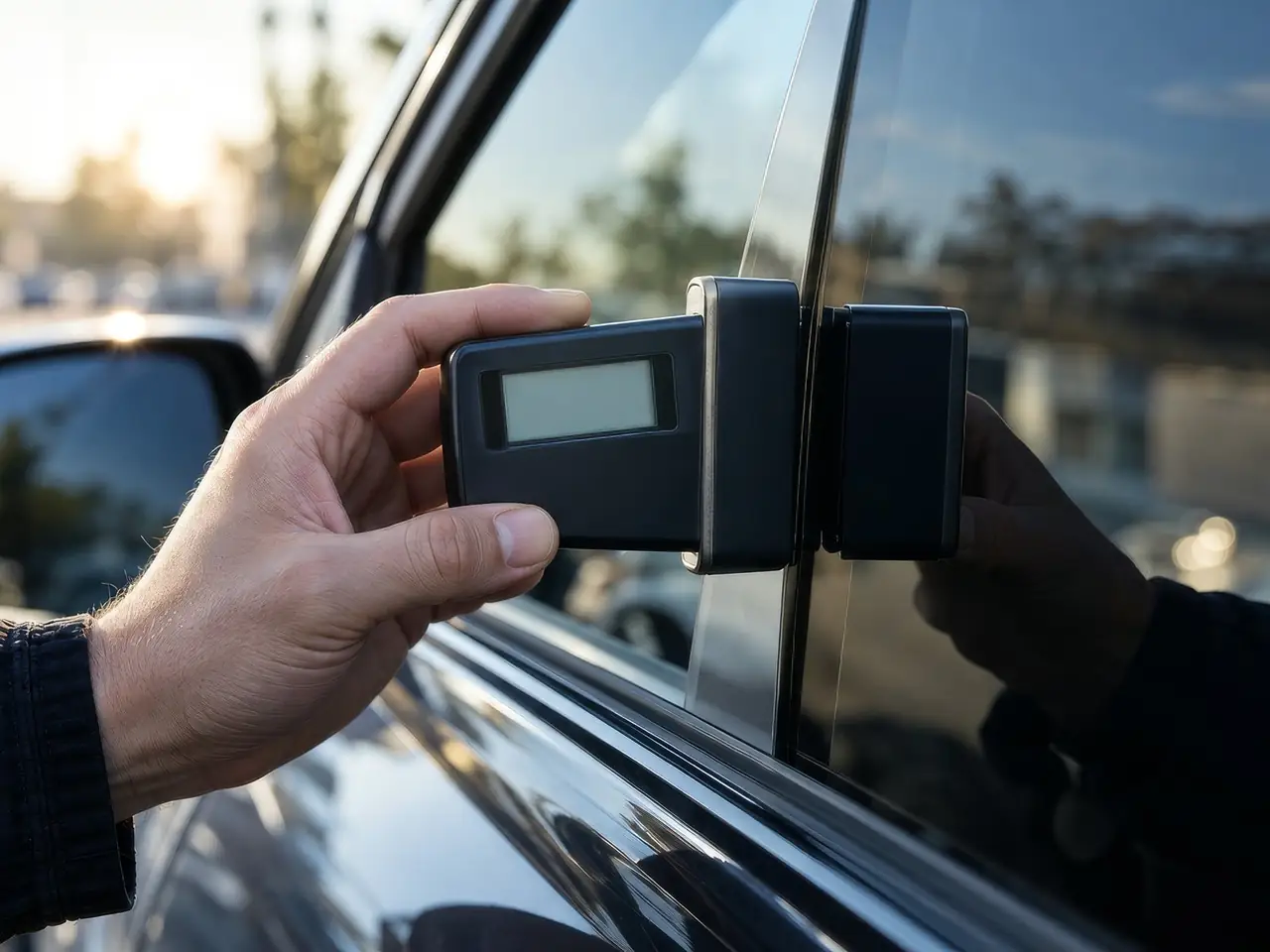
Checking whether tint laws changed
How do I check whether tint laws changed?
Each state page links the official source and shows the date we last verified it. Open the official source for your state and check your state's current rules before you quote or install. This guide is general information, not legal advice.
Do window tint laws change?
Yes. State legislatures and agencies can change tint rules, so a rule that was right earlier may not be today. The state tint laws guide links the official source for each state. Check your state's current rules there before you quote or install.

Is there one national window tint law?
No. Each state sets its own limits, so the same film can be legal in one state and not in another. Use the state tint laws guide to check the one you need, and check your state's current rules.
Which states have the strictest window tint laws by state?
For passenger cars, the table shows the highest front side minimum, 70% VLT, in Alaska, Iowa, New Hampshire, New York, Pennsylvania and Rhode Island. California, Michigan and Vermont show front side tint as restricted. Check with your state before you quote.
What is the lowest tint limit by state?
Among states with a confirmed figure, New Mexico has the lowest front side minimum in the table, 20% VLT, followed by Montana and Washington at 24%. A lower VLT number means darker film. Check with your state before you quote a shade.
Which states allow any darkness on back and rear windows?
For passenger cars, the legal tint by state table shows any darkness on both back side and rear windows in Arizona, California, Delaware, Illinois, Iowa, Maine, Michigan, Missouri, Nevada, North Dakota, Ohio, Texas, Utah and Vermont. SUV and van limits are on each state page. Check with your state before you quote.
Does the table list windshield tint rules?
No. The table covers front side, back side and rear windows, because windshield rules vary a lot by state. Some allow a strip near the top and some set a minimum VLT. Open your state's page for its windshield rule, then confirm at the official source.
What does Confirm with your state mean in the tint laws by state table?
It marks a state whose limits are not fully confirmed in our data, such as Alabama, Colorado or Tennessee. Treat those numbers as a starting point only, and check the state's official source before you quote or install. This is a guide, not legal advice.